
Two Tracks for Orange County Public Records
New York splits public records into two systems. The first is agency records. These fall under the Freedom of Information Law, known as FOIL, set in the Public Officers Law, Article 6. FOIL opens many executive and local agency files, such as sheriff administrative records and county department papers, subject to exemptions. The core access section is Public Officers Law § 87, which tells agencies to make records available and lists the limits, including law-enforcement and privacy carve-outs.
The second track is court records. Court files do not go through FOIL. The NY Courts FOIL page states plainly that court-record requests should not be sent to the Office of Court Administration under FOIL, because access to court records is governed by Judiciary Law § 255 instead. So a request for a sheriff report may be a FOIL request, while a request for a case file goes to a court clerk. The lead-in below points to the statute that anchors the agency track.
The official FOIL access section is shown below, hosted on the New York Senate Public Officers Law § 87 page.
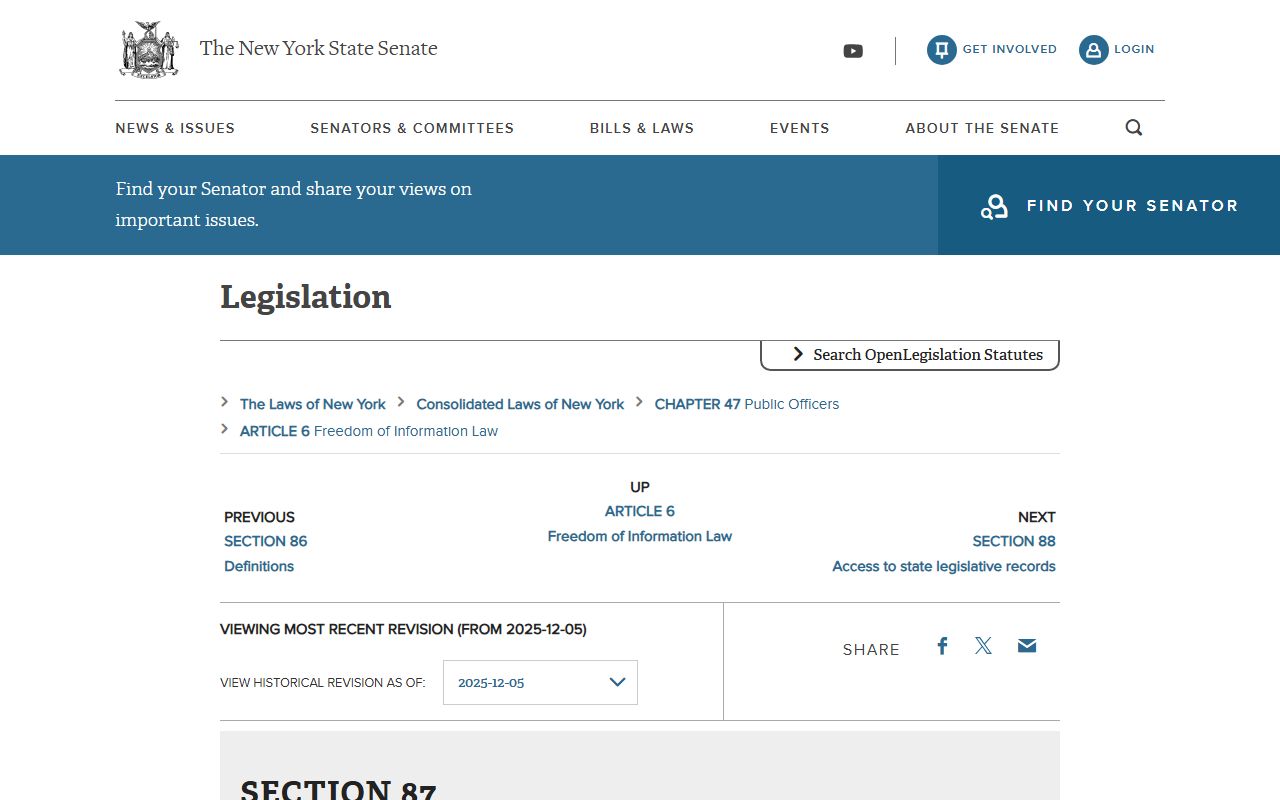
Section 87 sets the duty to disclose agency records and the exemptions that can keep some files closed, which shapes every Orange County FOIL request.
What the Orange County Clerk Maintains
The County Clerk holds a deep set of records beyond court files. This office is the county's records hub in Goshen. It records land documents and keeps the index of deeds and mortgages. It also files business certificates, UCC filings, and maps. Other functions include notary, passport acceptance, naturalization records, and veteran discharge papers. Some of these are open to anyone, while others carry privacy or statutory limits.
Online land records run through IQS, a records company the county links directly. Image access is paid and set by account type. The categories below show the main record groups the Clerk maintains.
- Deeds, mortgages, and other recorded land records.
- Business certificates and UCC filings.
- Maps and survey filings.
- Notary, passport acceptance, and naturalization records.
- Veteran discharge papers and historical documents.
Land records are the heart of the office. Every deed, mortgage, and lien recorded in Orange County leaves an index entry and an image here. Business certificates, often called DBA filings, register a trade name. UCC filings secure interests in personal property. Maps and survey filings record subdivision and boundary work; the Clerk FAQ notes maps may be filed only until 4:30 p.m. The office also acts as a passport acceptance agent and a notary registrar, and it keeps naturalization records and veteran discharge papers. Pistol permitting runs from 9 a.m. to 4:30 p.m. So the County Clerk wears many hats beyond the courthouse files.
The County Clerk online records page is shown below, with the IQS access and fee details, on the Orange County Clerk online records page. More on the office sits on the Orange County Clerk page.
Orange County Online Records Fees
The County Clerk's online land records are paid, not free. The county publishes the IQS access fees by account length and by whether you print or download images. A short, one-day option works for a single search, while the 90-day accounts fit heavier users. The fee table below sums the published costs.
| Item | Amount |
|---|---|
| IQS one-day account | $15 |
| IQS one-day print/download | $5 per document |
| IQS in-state account (90 days) | $150 |
| IQS out-of-state account (90 days) | $600 |
| IQS 90-day print/download | $0.50 per page |
Questions about the online record search go to IQS at 800-320-2617. The county also lists fixed fees for certain payments into court, such as $8 for a mechanic's lien or surplus money request and $25 for a broker's affidavit. Those court-payment items require a certified or bank check or a money order.
How to File a Public Records Request
A FOIL request asks a county or state agency for its records. The process is short, but a clear request gets a faster answer. You aim the request at the agency that holds the record, not at a court clerk. Reasonable copy fees may apply. The steps below lay out a basic FOIL request for agency or sheriff records.
- Find the agency that holds the record. For a sheriff report, that is the Sheriff's Office; for a county department file, that department's records officer.
- Put the request in writing and describe the records as clearly as you can. A date range, an incident number, or a name speeds the search.
- Send the request to the agency's Records Access Officer and keep a copy and the date.
- Wait for the agency response. It may grant, deny, or ask for more time, and may charge reasonable copy fees.
- If the agency denies the request, file an administrative appeal in writing.
Note: Court case files are not FOIL records, so route any request for a case file to the proper court clerk instead of an agency Records Access Officer.
Orange County FOIL Appeals and Review
A denied request is not the end. The appeal procedure lives in Public Officers Law § 89. You file a written appeal with the agency, and the appeal is determined within ten business days. If the agency still denies access, you can seek court review under CPLR Article 78. That is the formal path to challenge a refusal. Section 89 also sets the procedures and timing that agencies must follow when they handle FOIL requests.
The official FOIL appeals section is shown below, on the New York Senate Public Officers Law § 89 page.
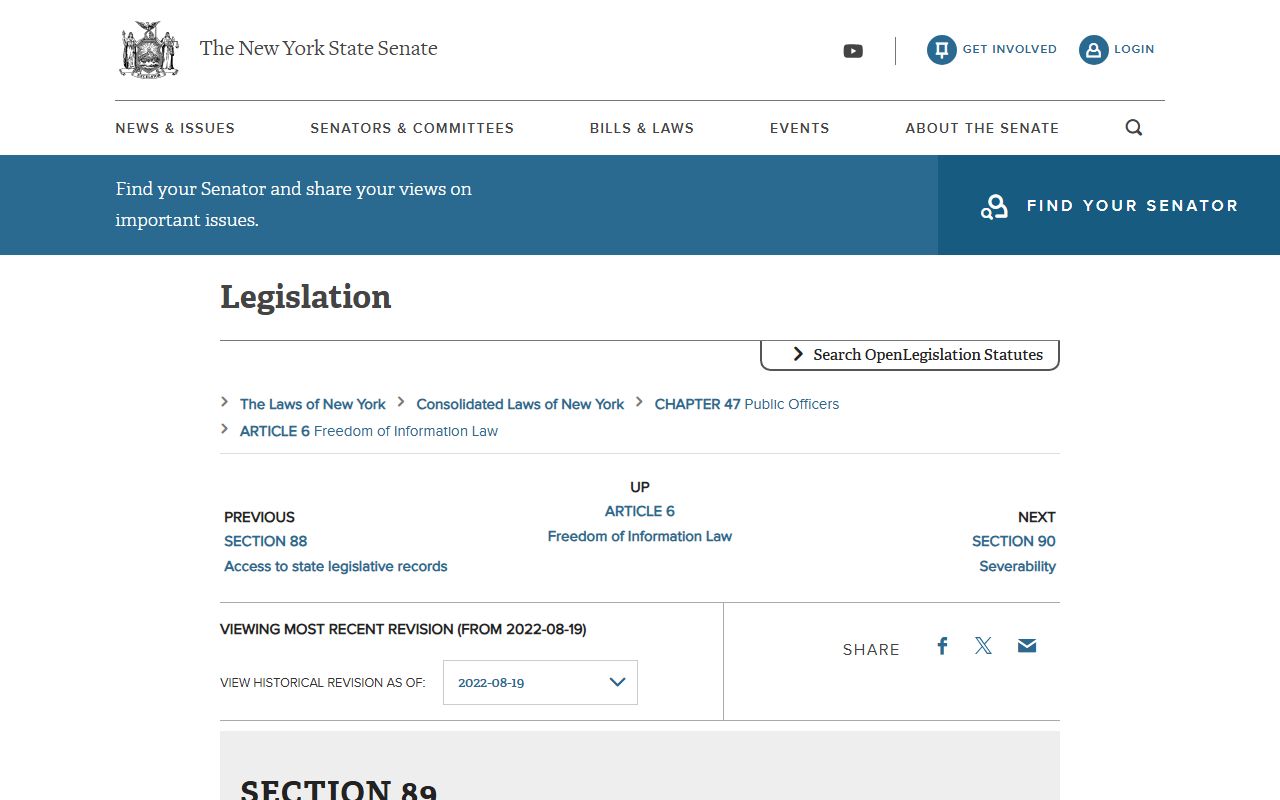
Section 89 gives the ten-business-day appeal window and the Article 78 review route, which together form the enforcement path for a denied Orange County FOIL request.
Orange County Records Request Fields
When you ask the County Clerk to pull a court-related document, the office wants specific details. The same care helps with any records request. The inventory below mirrors the County Clerk's record-request fields, drawn from its copy-ordering guidance.
| Field | What to Provide |
|---|---|
| Index number | The unique case ID; the Clerk asks for it when ordering documents. |
| Type of record | The specific record you want, such as a judgment or recorded deed. |
| Filing date | A date that helps locate the right file. |
| Names of parties | Plaintiff, defendant, or the business name on the record. |
| Requester identification | ID where the record is restricted to parties or authorized persons. |
For Family Court records, the Clerk routes requesters to Family Court at 845-476-3520, since those files do not sit with the County Clerk. For sheriff and jail matters, custody questions go to the jail or VINELink, and inmate detail is covered on the arrest records page. A clear index number does more to speed a file pull than any other detail you can give the Clerk.
Vital Records and Sheriff Records
Vital records do not centralize at the county. Marriage records come from the town or city clerk that issued the license. Birth and death records come from the local registrar of the municipality where the event happened. So a marriage search starts with the issuing municipality, not the County Clerk in Goshen. There is no single county vital-records desk that holds every birth, death, and marriage. You match the record to the place. A marriage from Newburgh goes to the Newburgh clerk; a birth in a given town goes to that town's registrar. More on this routing, and on certified marriage copies, sits on the marriage and divorce records page.
Sheriff and jail records follow the agency track. Many sheriff administrative records fall under FOIL, subject to law-enforcement and privacy exemptions. Those agency records run on Public Officers Law § 87 for access and Public Officers Law § 89 for appeals. A denied FOIL request gets an appeal decision within ten business days, and a continued denial may be reviewed under CPLR Article 78. Court case files are different. They do not run on FOIL at all. They fall under Judiciary Law § 255, which puts the duty to search and certify on the court clerk. The county does not post a public online jail roster in the sources reviewed, so custody checks run through the jail phone line or VINELink. Agency records and court records stay on separate paths even when they touch the same incident.
Restricted Orange County Records
Some records stay closed no matter how you ask. Each closure rests on a named law. Family Court files are restricted under Family Court Act § 166, which keeps them from indiscriminate public inspection. Matrimonial and divorce files are limited under Domestic Relations Law § 235 to parties, their attorneys, or a court order. Sealed criminal cases are closed under the sealing statutes in CPL Article 160, which cover dismissals, qualifying convictions, and Clean Slate sealing. The identity of a sex-offense victim is protected by Civil Rights Law § 50-b. Surrogate's Court confidential personal information is blocked under 22 NYCRR § 207.64.
These limits apply across both tracks. A FOIL exemption can shield a privacy-sensitive agency file, and a court rule can shield a sensitive case file. To reach a restricted record, a person usually must be a party, an attorney of record, or hold a court order. Adoption files and grand-jury minutes are closed too, and youthful-offender records carry their own protection. For the court-side framework, see court records, and for estate confidentiality, see Surrogate's Court. The arrest-record sealing tracks are covered on the arrest records page.