
What Orange County Family Court Handles
Family Court hears child and family matters, and every county in New York has one. Orange County Family Court takes a broad range of cases. It hears custody and visitation, child support, spousal support, paternity, and orders of protection. It also hears abuse and neglect cases, adoption, guardianship, juvenile delinquency, and PINS, which stands for a person in need of supervision. Foster-care review is part of the docket too.
One thing stands out: Family Court does not handle divorce. Divorce, separation, and annulment are Supreme Court matters in New York. People often file in the wrong place because Family Court deals with custody and support, which feel tied to divorce. They are separate. The divorce itself goes to the Supreme Court, while custody and support can run through Family Court. This court also keeps filing free, which removes a cost barrier for many families.
Orange County Family Court Contact and Judges
Orange County Family Court sits in the main courthouse on Main Street in Goshen, the same building as the Supreme and County Court. Hours run Monday through Friday from 9 a.m. to 5 p.m. The contact card below lists the office.
Orange County Family Court
285 Main Street
Goshen, NY 10924
845-476-3520
Fax 914-259-6883
Mon-Fri 9 a.m.-5 p.m.
The court's judges are Hon. Amanda B. Brady, Hon. Victoria B. Campbell, AJSC, Hon. James M. Hendry III, and Hon. Christine Krahulik. Chief Clerk Diane S. Gould runs the court's daily operations, with Deputy Chief Clerk Denise Memmelaar. Support magistrates hear many child support and paternity matters. For clerk roles, see the court clerk offices page.
Orange County Family Court Case Types
Family Court covers a wide set of family and child matters. Each type follows its own rules, but all of them touch families and children. The list below sets out the main case types this court hears.
- Custody and visitation between parents or guardians.
- Child support and spousal support, often heard by a support magistrate.
- Paternity to establish a legal father.
- Orders of protection in family offense matters.
- Abuse and neglect cases brought to protect a child.
- Adoption and guardianship of a child.
- Juvenile delinquency, PINS, and foster-care review.
These cases often overlap. A single family may have a custody case, a support case, and a protection order at once. The court tries to coordinate related matters. Many of these files carry confidentiality and child-identity protections, which shapes who can read them.
The reach is wide. Paternity cases set a legal father, which then opens the door to support. Spousal support can be heard here even though the divorce itself cannot. Orders of protection in family offense cases give a quick path to safety. Abuse and neglect cases let an agency step in to protect a child, and foster-care review keeps an eye on placements over time. Juvenile delinquency and PINS deal with the conduct of minors. Adoption and guardianship settle who has lawful care of a child. Across all of them, two facts hold steady. Filing is free, and the records are closed under Family Court Act § 166. And none of these cases is a divorce, since the divorce goes to the Supreme Court instead.
Why Orange County Family Court Records Are Confidential
Family Court records are not open to the public the way a civil case file is. The law keeps them closed. The state self-help site, NY CourtHelp, states plainly that Family Court records are not open to public inspection. This is a sharp contrast with Supreme Court civil files, which the public can usually view.
The legal anchor is the Family Court Act. The text and the courts treat these records as closed to indiscriminate public viewing, though a judge may permit inspection in some cases. The lead-in below links the statute. The screenshot shows the official text page for New York Family Court Act § 166.
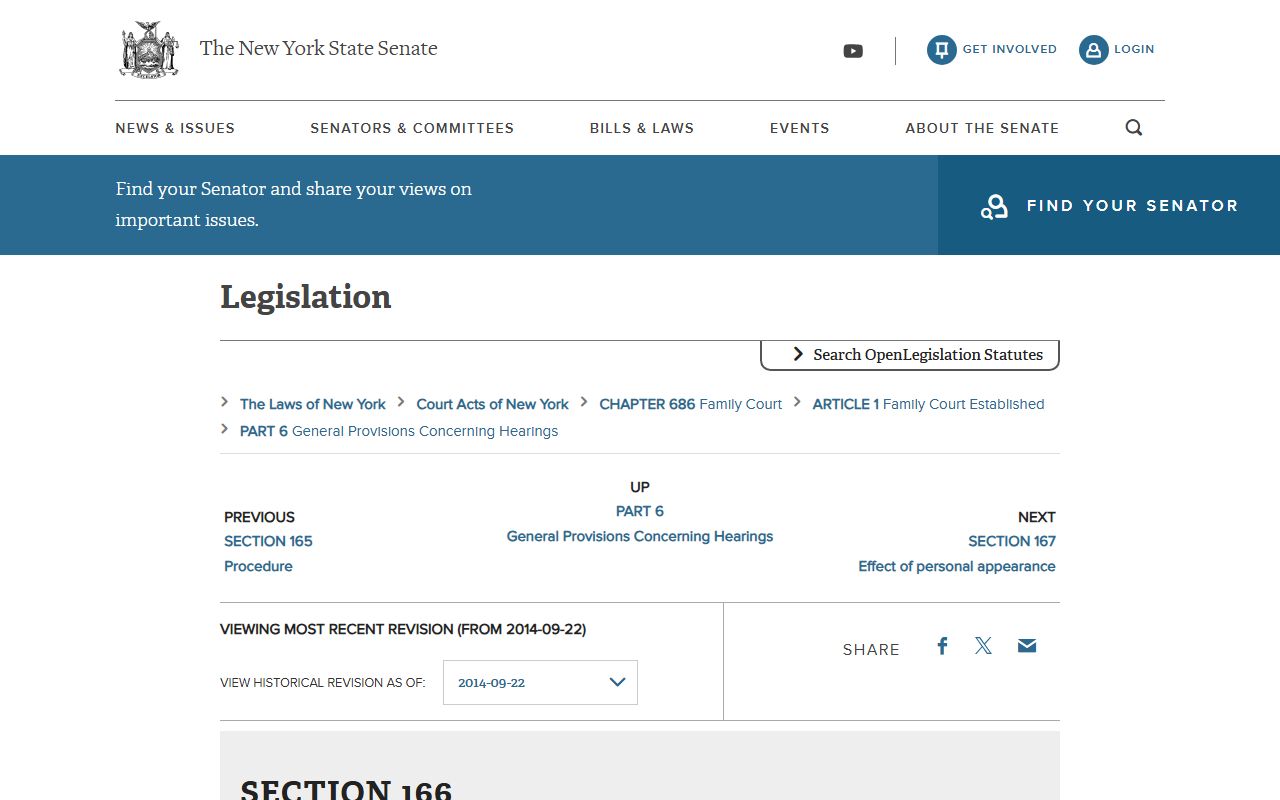
So who can see a Family Court file? Generally the parties, their attorneys, and certain agencies, depending on the case type and any court order. A stranger cannot pull a custody file the way they might pull a foreclosure record.
Important: Orange County Family Court records are confidential under Family Court Act § 166. Public access is limited; parties, attorneys, and authorized persons may view files, often only with court permission.
Family Court Terms Explained
Family Court uses words that have specific legal meaning. A quick read of the common ones helps anyone follow a case or a record. The list below defines the terms that come up most.
- Custody
- The legal right to care for and make decisions for a child.
- Visitation
- The court-set time a parent or relative spends with a child.
- Petitioner
- The person who starts a Family Court case by filing a petition.
- Order of protection
- A court order that limits contact to protect a person from harm.
- PINS
- A person in need of supervision; a minor whose behavior brings them to court.
Mediation and ADR in Orange County Family Court
Orange County Family Court refers many cases to mediation before the first appearance before a judge. A neutral leads the talks. The neutral cannot force a deal, and the parties never have to settle. Custody, visitation, child support, and some PINS parent-child matters are common candidates for mediation.
The point of this process is to let families work out an agreement without a contested hearing. A neutral is trained to guide the conversation, not to rule on it. So the neutral never decides who wins. If the parties reach terms, those terms can be written up and brought back to the court. If they do not, the case simply moves forward to the judge as it would have anyway. Nothing is lost by trying. The court's local ADR rules treat mediation as a first step for the right kinds of cases, which is why a custody or visitation matter may be sent there before a judge ever hears it. Note: mediation is voluntary in outcome, so a party who does not want to settle keeps the right to a full hearing.
Self-Help and Family Court Resources
Filing in Family Court is free, which is a real difference from many other courts. There is no fee to file a petition for custody, support, visitation, or a family offense. That keeps the courthouse door open to families who cannot pay. A litigant without a lawyer still has several official tools to lean on.
The state runs NY CourtHelp, a self-help site with plain-language guides and statewide do-it-yourself forms for many Family Court matters. The court itself offers a Family Court Children's Center, a supervised space for children while a parent is in court. There is also a "Free Legal Help with Child Support Matters" resource linked from the court. For case status, the state runs WebFamily, an online tool tied to Family Court cases. For people who cannot afford a lawyer, the Legal Aid Society of Orange County represents eligible clients in Family Court matters; its intake line is 845-291-2454. These resources are good first stops before a hearing. For the appeal path and the wider court structure, see the Supreme Court page.
Who Can Access Orange County Family Court Records
Because the files are closed, access turns on who you are and why you ask. The parties to a case can usually see their own file. So can their attorneys of record. Certain agencies tied to a case, such as a child protective agency or a support unit, may have access for their role. Beyond that group, a person generally needs the court's permission.
The Family Court Act lets a judge permit inspection in the court's discretion. That means a request is not always a dead end, but it is not open the way a civil file is. A stranger curious about a neighbor's custody case will not get the file. A grandparent or a guardian with a stake in a matter may have a path, often through the court or an attorney. The County Clerk does not hold these files and routes Family Court record questions to the court at 845-476-3520, as noted on the Orange County Clerk page.
This restriction protects children and families. Custody, abuse, neglect, and juvenile matters all carry real privacy stakes. The closed-file rule is the law's way of guarding that.
Family Court Is Not Divorce Court
This point is worth its own section because the mix-up is so common. Family Court does not grant divorces. In New York, divorce, separation, and annulment are Supreme Court matters. Family Court can decide custody, support, and protection, but it cannot end a marriage.
So a person seeking a divorce files in Supreme Court, even if custody and support questions are part of the split. The Supreme Court can handle the whole package in a matrimonial case, or some issues may run in Family Court at the same time. The divorce file itself is restricted and runs through the County Clerk's Court Papers section. For the steps and access rules, see the marriage and divorce records page and the Orange County Clerk page.